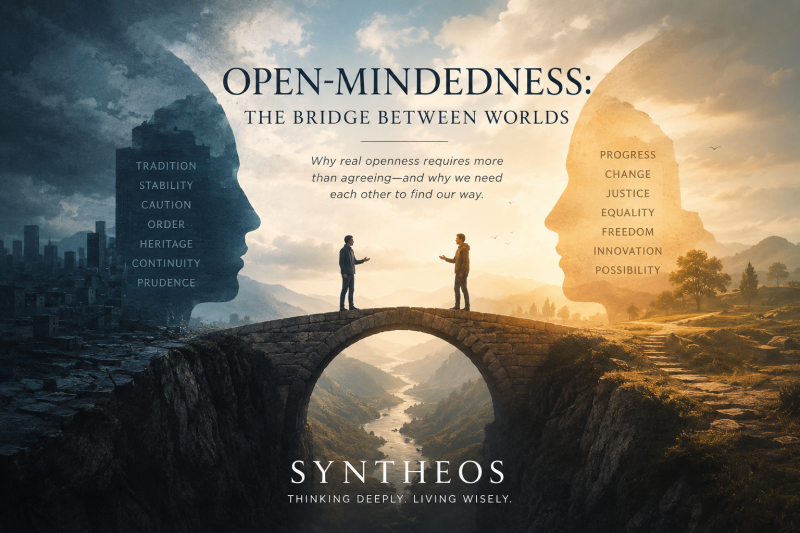
Open-Mindedness or Modern Tunnel Vision?
When openness becomes an identity
Being “open-minded” has increasingly become a kind of moral badge of honor. Particularly within progressive circles, the term is often used as evidence of intellectual and moral maturity. People present themselves as open to change, new ideas, diversity, and social reform. In theory, these are valuable qualities.
But this is precisely where an interesting paradox emerges.
What happens when a group sees itself as open-minded while becoming less and less willing to seriously engage with opposing perspectives? What happens when conservative viewpoints are no longer treated as ideas worthy of discussion, but as outdated, morally inferior, or simply illegitimate?
Then an uncomfortable question arises:
Is open-mindedness still truly open-mindedness when certain conclusions become socially forbidden territory?
Open-mindedness is not a political direction
There is a fundamental difference between progressivism and open-mindedness.
That distinction is increasingly being lost.
Open-mindedness does not automatically mean:
- being progressive;
- voting left-wing;
- rejecting traditional structures;
- or embracing every form of social change.
True open-mindedness means something else entirely:
The willingness to honestly examine ideas, arguments, and perspectives — even when they conflict with your existing beliefs.
That requires intellectual flexibility. It requires the ability to say:
“I hadn’t looked at it that way before.”
Or even:
“Maybe I was partially wrong about that.”
And that ability seems to be becoming increasingly rare.
For many people, changing their mind no longer feels like growth.
It feels like defeat.
As if admitting someone else has a valid point automatically means weakness or failure.
But in reality, the opposite is often true.
When beliefs become identities
A large part of modern polarization exists because political beliefs are no longer treated merely as ideas.
They are treated as identities.
People therefore do not only defend their opinions.
They defend their tribe.
And once a belief becomes tied to social identity, a psychological problem emerges:
New information is no longer evaluated based on truth, but on one question:
“Does this fit within my side?”
This mechanism exists on both the left and the right.
Extremes on both sides can fall into tunnel vision.
But when a group explicitly presents itself as tolerant, open, and intellectually free, it becomes especially noticeable when dissenting opinions are immediately dismissed as ignorant, dangerous, or morally suspicious.
At that point, open-mindedness slowly transforms from an intellectual virtue into a cultural identity label.
And that is a dangerous development.
A healthy society needs both forces
A functioning society does not thrive because one political ideology permanently wins.
It thrives through constant correction between opposing forces.
Progressive movements play an important role:
- they identify injustice;
- encourage reform;
- and challenge stagnation.
But conservative movements also serve an essential function:
- they protect stability;
- warn against unintended consequences;
- and preserve social continuity.
When either side becomes completely dominant, society loses balance.
Pure progressivism can drift into rootlessness, ideological experimentation, and permanent cultural instability.
Pure conservatism can harden into rigidity, fear of change, and institutional paralysis.
That is exactly why both sides need each other.
Not to destroy one another.
But to keep one another sharp.
To correct each other’s blind spots.
To soften each other’s harsher edges.
Polarization destroys curiosity
The problem with modern polarization is not simply disagreement.
Disagreement is normal.
The real problem begins when people no longer see one another as fellow citizens with different priorities, but as fundamentally bad, irrelevant, or unintelligent people.
At that point, curiosity disappears.
And without curiosity, genuine dialogue disappears with it.
Then a culture emerges in which:
- listening appears weak;
- doubt feels like betrayal;
- and nuance becomes suspicious.
Yet intellectual growth begins precisely with the willingness to let yourself become temporarily uncertain.
Not because you should abandon all convictions.
But because no human being knows everything.
No ideology is complete.
And no group is immune to tunnel vision.
The courage to take a detour
Perhaps true open-mindedness is ultimately far simpler than modern culture has made it.
Not endless relativism.
Not blindly accepting everything.
But simply:
remaining willing to be surprised.
Human beings grow through unexpected perspectives, difficult conversations, and encounters with ideas outside their own bubble.
A completely closed worldview may feel safe.
But it also becomes rigid.
Predictable.
Intellectually impoverished.
If you endlessly travel the same straight road, eventually you know exactly what you are going to see.
Perhaps real growth lies in occasionally taking a detour.
Not because every side road is better.
But because sometimes it is only outside your familiar route that you discover how limited your original map truly was.
And perhaps a healthier society begins exactly there:
With people who are not afraid to occasionally say:
“I need to think more about that.”
Reactie plaatsen
Reacties