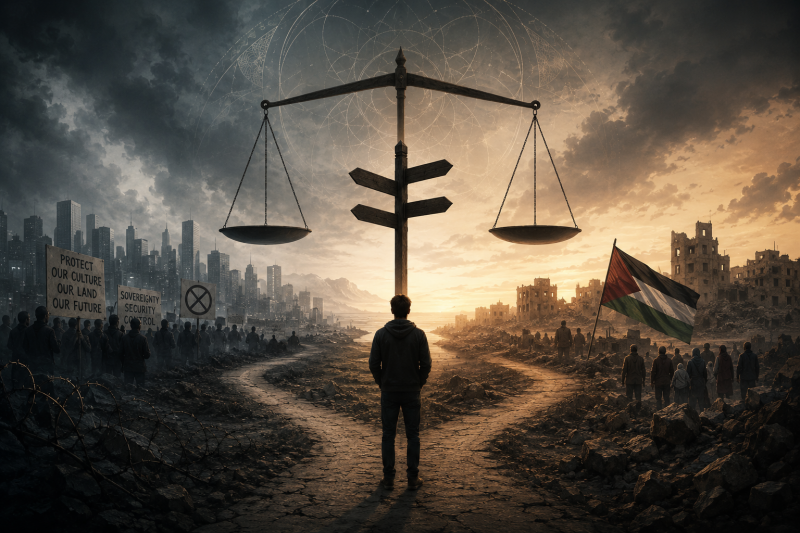
Group Loyalty Disguised as Morality
On hypocrisy, identity, and the disappearance of nuance
The world increasingly seems divided into camps that no longer merely disagree with each other, but no longer even attempt to understand one another. Discussions are no longer only about facts or solutions, but about identity. People feel connected to a group, a political movement, or a worldview, and once that worldview is challenged, many experience it as a personal attack.
And because of that, nuance disappears.
When morality becomes dependent on identity
This is especially visible today in discussions surrounding immigration, nationalism, and the conflict between entity["country","Israel","modern state established 1948"] and entity["place","Palestine","historical region in the Middle East"]. Not because these subjects are simple — quite the opposite — but because people increasingly begin from group identity instead of consistent principles.
One controversial yet philosophically interesting argument emerges from this:
People who justify violence or harsh repression against immigration in the West should, by the same logic, be able to understand Palestinian resistance.
Not because violence is desirable. Ultimately, violence is almost always a sign that societies and politics have failed. But when someone considers violence understandable in the context of protecting “their own country,” it becomes difficult to reject that same principle entirely when another population experiences a similar sense of loss.
Many anti-immigration movements in Europe speak about:
- the loss of national identity,
- cultural displacement,
- demographic change,
- and protecting “our country.”
But when Palestinians speak about the loss of territory, displacement, military control, or the feeling that their world is slowly disappearing, that same principle is often suddenly dismissed.
There is a clear moral tension in that.
The historical role of the West
Historically, the conflict surrounding Israel and Palestine is deeply complex. It is too simplistic to claim that one side is entirely right or wrong. Jewish communities had lived in the region for centuries, and the creation of Israel cannot be separated from centuries of persecution against Jews in Europe and the horrors of the Second World War.
At the same time, it is also true that the organized migration and state formation in an already inhabited territory fundamentally altered the balance of the region. Western powers played a major role in this process. Borders, governance, and geopolitical decisions were shaped in part by countries that ultimately did not have to live with the long-term consequences themselves.
This does not mean that “the West” alone is responsible, but it does mean that Western societies often underestimate how much influence they historically had in creating the conditions for many modern conflicts.
And perhaps that is exactly what is often missing in modern discussions: historical self-awareness.
People frequently speak about conflicts as if they emerge spontaneously from pure good and evil, while in reality many conflicts are rooted in decades or even centuries of geopolitical decisions, power structures, colonialism, economic interests, and collective trauma.
Universal principles or tribal thinking
Yet perhaps the most important point is not even who historically had the greater claim.
The most important point is that people rarely apply their principles consistently.
Freedom, security, self-determination, and human rights are often presented as universal values, but in practice they frequently depend on:
- cultural proximity,
- religion,
- political preference,
- media framing,
- or simply the group with which someone identifies.
That is why much of modern morality no longer feels universal, but tribal.
Group loyalty disguised as morality.
And this problem exists on both sides of the political spectrum.
Right-wing movements may speak passionately about national identity and the right to protect culture, while showing little understanding for Palestinian feelings of displacement or loss.
Left-wing movements may rightly criticize colonialism and Western power, while simultaneously romanticizing authoritarian or reactionary movements simply because they oppose the West.
In both cases, nuance disappears the moment one’s own tribe becomes central.
Polarization and the disappearance of growth
Perhaps that is also why societies continue to polarize. People no longer debate in order to deepen their understanding of reality, but to defend their side.
Anyone introducing nuance is quickly viewed as a traitor to their own camp.
But that is precisely where dangerous stagnation begins.
Because real growth often starts the moment someone is willing to admit they may not fully understand everything.
Many people experience changing their opinion as a form of defeat. As if admitting they were wrong automatically makes them weak. In reality, the opposite is often true.
It takes intellectual strength to critically examine one’s own beliefs.
No one grows by being endlessly reassured that they were already correct.
Growth emerges through confrontation with uncomfortable arguments.
Why nuance remains necessary
That does not mean everyone is always “partly right.” Truth does not literally always sit in the middle. Sometimes one side has stronger evidence or more convincing arguments.
But complex social and political issues can rarely be fully understood through a single perspective.
Culture alone explains nothing.
Economics alone explains nothing.
History without human emotion explains nothing.
And politics without historical awareness quickly deteriorates into shallow slogans.
Truth as an ongoing process
There is another important reality: truth is not static.
New information, newly uncovered documents, changing circumstances, and evolving perspectives can continuously reshape how conflicts and societies are understood. What people today consider absolute truth may appear far more nuanced twenty years from now.
Perhaps a healthy society therefore requires not absolute certainty, but intellectual humility.
The willingness to hold convictions without turning them into sacred truths.
No culture, ideology, or political system is perfect. Every society carries its own flaws, and often those flaws become more visible the longer a system exists.
Nationalism can create solidarity, but also exclusion.
Extreme individualism can bring freedom, but also alienation.
Strong welfare systems can strengthen solidarity, but also create dependency.
Every structure eventually contains tensions that become visible over time.
More than borders and groups
Perhaps that is also why people sometimes have more in common with someone on the other side of the world than with their own neighbor.
Human connection does not neatly follow borders, religions, or political labels.
Beneath almost every conflict lie the same human emotions:
- fear,
- loss,
- pride,
- identity,
- security,
- recognition,
- and the need to belong.
The moment societies begin to see people only as members of a group — left or right, Western or non-Western, immigrant or nationalist — nuance disappears, but so does the ability to genuinely learn from one another.
And perhaps wisdom begins precisely there:
Not in absolute certainty.
But in the realization that no individual, no group, and no society is ever completely free from blind spots.
Reactie plaatsen
Reacties